Defining subnet-based DeFi clusters
A subnet-based DeFi cluster is a collection of interconnected Avalanche subnets sharing liquidity, governance, or cross-chain messaging. This modular architecture moves beyond the monolithic model of single-chain Layer 1s, creating specialized blockchains that operate with sovereign control while remaining part of a unified financial infrastructure.
In this model, a subnet acts as a dynamic set of validators securing one or more blockchains. It serves as a permission layer or logical boundary, allowing institutions to tailor consensus mechanisms, virtual machines, and fee structures to specific DeFi needs. When multiple subnets are linked, they form a cluster—a network of specialized chains that move assets and data between each other without relying on a single, congested mainnet.
This structure addresses the scalability and customization limitations of monolithic L1s. By distributing workloads across a cluster, institutions achieve high throughput and near-instant finality for specific use cases, such as private trading or tokenized assets, while maintaining access to broader liquidity pools. The result is a flexible infrastructure that scales horizontally, allowing different DeFi applications to coexist efficiently.
How sovereign liquidity layers operate
Avalanche subnets function as independent Layer 1 blockchains that share the Primary Network for security but maintain complete control over their own execution rules. This architecture allows developers to design custom virtual machines (VMs) tailored to specific DeFi clusters, enabling near-instant finality and high throughput without being constrained by the general-purpose constraints of the base chain. Each subnet operates as a sovereign liquidity layer, defining its own governance, tokenomics, and consensus mechanisms while remaining interoperable with the broader Avalanche ecosystem.
The technical foundation rests on the interaction between these custom VMs and the Primary Network. When a subnet is created, it does not build its own validator set from scratch; instead, it borrows security from the Primary Network. To become a validator for a specific subnet, a node operator must first stake a minimum of 2,000 AVAX on the Primary Network. This requirement ensures that the same set of economically significant validators secures both the base layer and the sovereign subnets, creating a unified security model that prevents fragmentation of trust.
This shared security model allows subnets to focus entirely on execution efficiency. Whether a DeFi cluster requires a specialized EVM for complex financial instruments or a custom C++ VM for high-frequency trading, the underlying consensus and security are handled by the Primary Network. This separation of concerns distinguishes subnet-based DeFi clusters from traditional Layer 2 solutions, which often rely on sequencers or centralized operators. Here, the validator set remains decentralized and economically secured by AVAX, providing a robust foundation for sovereign liquidity.
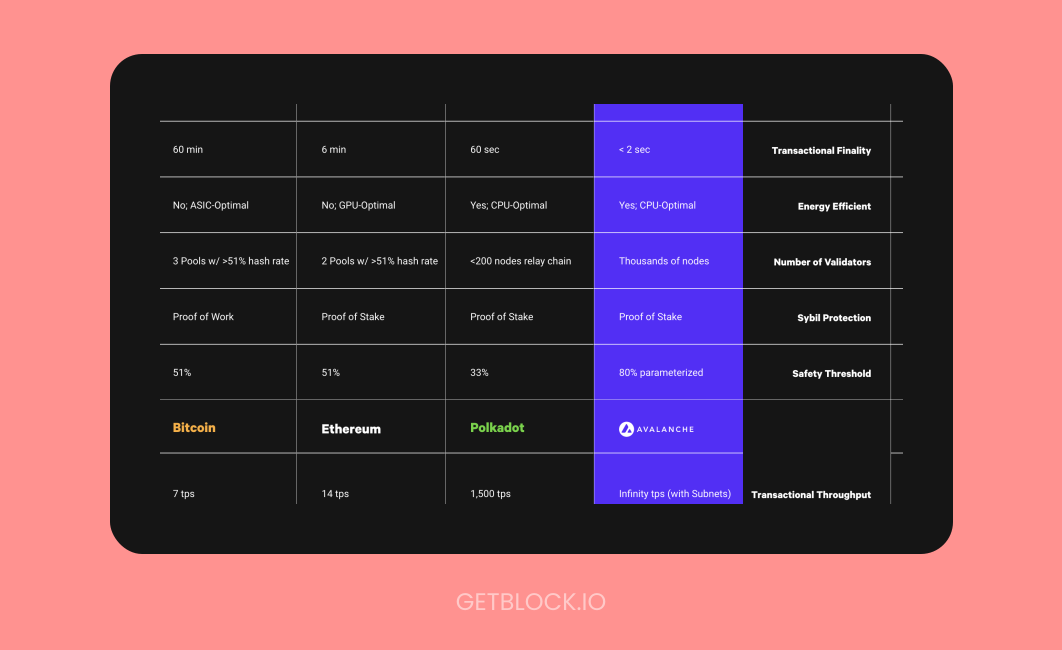
The Primary Network also serves as the settlement layer. Assets move between the Primary Network and subnets through atomic bridges, ensuring liquidity remains fluid across the ecosystem. This interoperability is critical for DeFi clusters requiring cross-chain composability. By keeping security and settlement on the Primary Network, subnets can optimize their execution environments for specific use cases without sacrificing decentralization.
Validator sets and network security
The security of a subnet is directly tied to the economic stake of its validators, drawn from the Primary Network. This creates a hierarchical security model where the Primary Network acts as the root of trust. Validator nodes must maintain their 2,000 AVAX stake on the Primary Network to qualify for subnet validation, ensuring that the economic cost of attacking a subnet is proportional to the value of the AVAX at risk. This mechanism prevents cheap attacks on smaller subnets and aligns validator incentives with the health of the entire Avalanche ecosystem.
While the Primary Network provides the security backbone, subnet operators have the flexibility to choose which validators secure their specific chain. This allows for a tiered security model: high-value DeFi clusters can opt for a larger, more diverse set of validators, while smaller or experimental subnets can operate with a smaller, specialized group. This flexibility allows for customization of the security-performance trade-off based on the needs of the DeFi cluster.
The consensus mechanism used by subnets is typically Avalanche Consensus, a novel family of protocols providing finality in under one second. This speed is achieved through repeated sub-sampling of the validator set, allowing nodes to quickly reach agreement on the state of the blockchain. The combination of fast finality and shared security makes subnets ideal for DeFi applications requiring real-time settlement and high reliability.
Interoperability and asset bridging
Interoperability is a core feature of the Avalanche subnet architecture, enabling seamless asset transfers between the Primary Network and subnets. This is achieved through atomic bridges, which ensure that assets are locked on one chain and minted on the other in a single, atomic transaction. This mechanism prevents double-spending and ensures that the total supply of assets remains constant across the ecosystem. For DeFi clusters, this means liquidity can flow freely between different subnets, allowing for complex composability and cross-chain yield strategies.
The bridging process is designed to be trust-minimized, relying on the cryptographic guarantees of the Avalanche consensus protocol rather than centralized intermediaries. This reduces the risk of bridge hacks, a significant vulnerability in other blockchain ecosystems. By keeping the bridging logic on-chain and leveraging the shared security of the Primary Network, Avalanche provides a more secure foundation for cross-chain asset movement.
This interoperability also extends to governance. Subnet operators can design governance mechanisms tailored to their specific needs, whether that involves on-chain voting, off-chain signaling, or hybrid models. However, the underlying security and settlement remain anchored to the Primary Network, ensuring that governance decisions are backed by the economic strength of the AVAX token. This balance of sovereignty and security makes subnet-based DeFi clusters a compelling option for developers and users.
Avalanche subnets versus layer two scaling models
Choosing between Avalanche subnets and Layer 2 (L2) rollups like Arbitrum or Optimism is a decision about where you place your trust. For institutional DeFi, the trade-off is rarely just about speed; it is about sovereignty versus shared security. Subnets give you a dedicated blockchain with custom rules, while L2s offer a cost-effective way to scale Ethereum’s existing security model.
Sovereignty and customization
Avalanche subnets are independent blockchains connecting to the Avalanche primary network. They allow institutions to define their own consensus mechanism, virtual machines, and governance rules. This is critical for compliance-heavy use cases, such as tokenized real-world assets, where regulatory requirements might differ from standard Ethereum smart contracts. You control the validator set and the economic parameters, reducing reliance on a central sequencer or a shared base layer.
Layer 2 rollups, by contrast, inherit Ethereum’s security. They process transactions off-chain and post proofs to the mainnet. While this offers robust security through Ethereum’s massive validator network, it limits customization. You must adhere to Ethereum’s EVM standard and accept the latency of finality on the base layer. For institutions needing to integrate with existing Ethereum liquidity pools, L2s provide a seamless bridge. For those needing isolated, permissioned environments, subnets offer the necessary control.
Security and interoperability
The security model of a subnet depends on its validator set. A subnet with a small, permissioned validator set is fast but less decentralized. A public subnet with thousands of validators offers higher security but requires more coordination. Avalanche’s primary network provides a shared security layer, but each subnet ultimately defines its own threat model.
L2s benefit from Ethereum’s economic security. However, they introduce new attack vectors, such as sequencer centralization or bridge vulnerabilities. Interoperability between L2s remains fragmented, often requiring complex bridging solutions that increase risk. Subnets on Avalanche can be configured to communicate directly with each other and the C-Chain, creating a cohesive ecosystem for institutional DeFi clusters without the fragmentation issues common in the multi-L2 landscape.
Institutional fit
The choice depends on your specific operational needs. If you require strict compliance, custom governance, and isolated risk, an Avalanche subnet is the superior architecture. If you need to tap into Ethereum’s deep liquidity and prioritize shared security over customization, an L2 is the practical choice.
| Feature | Avalanche Subnet | Layer 2 Rollup |
|---|---|---|
| Consensus | Customizable (Snowman, PoS) | Inherited from Ethereum (PoS) |
| Security Model | Validator-set dependent | Shared Ethereum security |
| Customization | High (VM, Governance) | Low (EVM Standard) |
| Finality | Sub-second to seconds | Seconds to minutes |
| Liquidity Access | Requires bridging | Native Ethereum access |
Decision framework
Institutional builders should start by defining their risk tolerance. If regulatory isolation and custom compliance are non-negotiable, the subnet architecture provides the necessary tools. If the priority is minimizing infrastructure overhead and leveraging Ethereum’s security, L2s offer a proven path. Both models have distinct advantages, and the right choice depends on the specific operational and financial goals of the institution.
Institutional liquidity and compliance needs
Institutional capital requires a regulatory environment that mirrors traditional finance. Public blockchains often struggle with this because they treat all participants equally, regardless of identity or jurisdiction. Subnet clusters solve this by allowing institutions to build sovereign Layer 1s with embedded compliance. This architecture enables KYC and AML checks at the protocol level, ensuring that only verified entities can interact with specific liquidity pools or asset classes.
This capability is a prerequisite for large-scale adoption. By integrating identity verification directly into the blockchain’s consensus layer, institutions can meet regulatory requirements without relying on opaque off-chain solutions. This transparency reduces legal risk and builds trust among regulators, who can audit the network’s compliance posture in real time.
Custom asset standards further enhance this appeal. Institutions often need to tokenize real-world assets (RWAs) that must adhere to specific legal frameworks, such as securities laws or commodity regulations. Subnets allow developers to create custom virtual machines and asset standards that enforce these rules natively. For example, a subnet can restrict token transfers to whitelisted addresses or enforce holding periods, ensuring that the digital representation of the asset remains compliant with its underlying legal structure.
Predictable transaction costs are equally critical. Institutional traders cannot operate effectively in an environment where gas fees spike unpredictably during network congestion. Subnets isolate transaction loads, providing stable and low-cost execution. This predictability allows institutions to model their operational costs accurately and execute large trades without the risk of front-running or excessive slippage caused by volatile fee markets.
Validator staking and security requirements
Securing an Avalanche subnet is a significant economic commitment. Before a validator can even interact with a subnet, they must first join the Primary Network. The barrier to entry here is steep: operators must stake a minimum of 2,000 AVAX.
This requirement acts as a gatekeeper for the entire ecosystem. It ensures that those managing the underlying infrastructure have substantial skin in the game, aligning their financial interests with the network's stability. At current market rates, this stake represents a capital outlay often exceeding $20,000, filtering out casual participants and establishing a baseline of serious commitment.
Beyond the Primary Network threshold, subnet-specific staking adds another layer of complexity. While the base requirement is uniform across the Primary Network, individual subnets may impose their own additional staking rules or validator sets. This dual-layer approach means that securing a specific DeFi cluster requires not just meeting the global standard, but also adhering to the particular security parameters of the subnet in question.
The economic friction of this high stake is intentional. It discourages Sybil attacks and ensures that validators are financially motivated to act honestly. For teams building DeFi clusters, understanding this economic moat is critical, as it directly impacts the decentralization and security posture of their chosen infrastructure.
Implementation checklist for subnet deployment
Deploying a subnet-based DeFi cluster requires precise configuration to ensure isolation and liquidity efficiency. Follow this ordered workflow to build, validate, and launch your subnet on the Avalanche network.
Install the Avalanche-CLI and authenticate with your Avalanche wallet. Configure your local environment variables to point to the Fuji testnet for initial development, ensuring you have sufficient AVAX for transaction fees.
Create a subnet-evm configuration file. Specify the initial validator set, gas limits, and the custom token ID for your DeFi cluster’s native asset. This genesis state determines the economic rules and initial liquidity distribution.
Run avalanche subnet deploy to spin up a local subnet node. Verify connectivity by checking the node logs and ensuring the RPC endpoint responds to standard Ethereum JSON-RPC calls. This step confirms your subnet is operational before mainnet deployment.
Deploy your smart contracts (AMMs, lending pools) to the new subnet address. Use a block explorer like Snowtrace (for mainnet) or a local explorer to verify contract code. Ensure your contracts are compatible with the subnet’s specific EVM parameters.
Set up liquidity providers and define validator rewards. Bridge assets from the primary Avalanche C-Chain to your subnet using the Core Wallet. Monitor gas prices and adjust validator stakes to maintain network stability during the initial launch phase.
For real-time market context, monitor AVAX price movements to gauge network demand and transaction costs during deployment.
No comments yet. Be the first to share your thoughts!