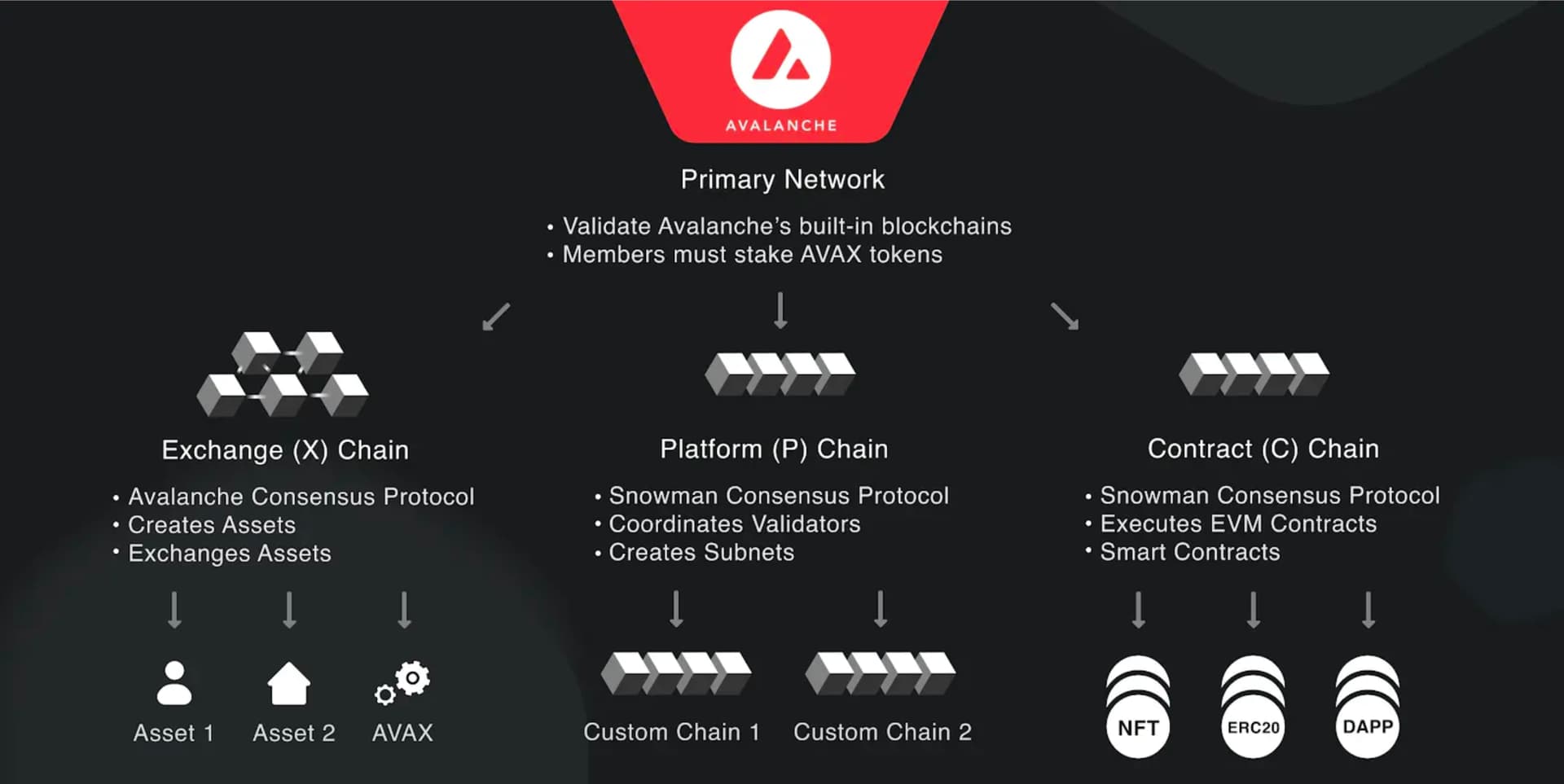
Defining the subnet-based DeFi cluster
To understand an Avalanche subnet-based DeFi clusters analysis, you first need to separate the concept of a subnet from the concept of a blockchain. In the Avalanche ecosystem, a subnet is not a blockchain itself. Instead, it is a dynamic subset of network validators that achieve consensus on one or more custom blockchains.
This distinction is critical for high-stakes financial analysis. When developers build on Avalanche, they are not just deploying contracts on a shared Layer 1 chain. They are creating application-specific blockchains that operate with custom rules, validators, and virtual machines. These custom chains still leverage the speed and security of the Avalanche consensus protocol, but they do so independently of the main network's transaction load.
Think of the primary Avalanche network as a global highway system. The subnets are the specific toll roads built on that infrastructure. Each toll road can have its own speed limits, vehicle restrictions, and pricing models, yet it remains connected to the broader network. This architecture allows DeFi protocols to tailor their economic and security parameters without congesting the main chain or compromising on decentralization.
For institutional players, this means that liquidity can be segmented into specialized environments. A subnet-based DeFi cluster can offer high-throughput trading with minimal fees while maintaining a specific validator set trusted by its participants. This structural flexibility is what differentiates Avalanche from traditional Layer 1s or simple Layer 2 rollups, where all users share the same rigid set of rules and security assumptions.
Infrastructure layers and VM flexibility
Building a subnet-based DeFi cluster requires more than just connecting protocols; it demands a technical stack that allows each layer to operate with specific execution and data availability rules. Avalanche’s architecture separates these concerns through its Virtual Machine (VM) layer, giving developers the freedom to customize consensus and state transitions without compromising the underlying network's security. This modularity is the foundation of any serious subnet-based DeFi clusters analysis, as it determines how efficiently capital can move between isolated liquidity pools.
At the core of this flexibility is the choice of VM. The Coreth VM powers the primary C-Chain, offering full Ethereum compatibility for developers who need to deploy existing Solidity smart contracts with minimal friction. However, for high-frequency DeFi applications, HyperSDK provides a more performant alternative. Built on Go, HyperSDK allows teams to define custom state machines and execution logic, enabling subnets to handle thousands of transactions per second while maintaining deterministic finality. This distinction is critical when analyzing the infrastructure capabilities of different DeFi clusters, as it dictates the throughput limits and gas efficiency of the underlying assets.
The separation of execution from consensus is what makes the subnet model robust. Validators on the primary Avalanche network secure the P-Chain and X-Chain, while subnet validators handle the specific consensus rules of their respective chains. This means a DeFi cluster can enforce its own data availability and validator set, creating a closed-loop economy that is isolated from the broader network's congestion. For institutional participants, this predictability reduces the risk of network-wide delays affecting trade execution. By leveraging these distinct infrastructure layers, subnet-based DeFi clusters can offer specialized environments that generic Layer 1s cannot replicate, balancing speed, cost, and regulatory compliance.
Comparing subnet architectures for DeFi
Building an Avalanche subnet-based DeFi cluster requires choosing the right architectural foundation. The network offers three primary models: public, private, and hybrid subnets. Each model balances decentralization, customization, and security differently. Selecting the wrong architecture can lead to regulatory friction or poor capital efficiency.
A public subnet shares validators with the main Avalanche C-Chain. This model offers maximum security and decentralization but limits customization. Private subnets use a dedicated validator set. This approach allows full control over rules and participants but requires the project to secure its own network. Hybrid models attempt to bridge the gap, offering custom rules while leveraging the main chain for settlement or liquidity.
The choice depends on your DeFi use case. Institutional custody solutions often require private subnets for compliance. Public gaming or consumer DeFi apps benefit from the shared security of public subnets. Understanding these tradeoffs is essential for a successful Avalanche subnet-based DeFi cluster analysis.
| Subnet Type | Validator Set | Customizability | Security Model | Best For |
|---|---|---|---|---|
| Public | Shared with C-Chain | Low (Standard EVM) | High (Mainnet) | Consumer DeFi, Gaming |
| Private | Dedicated, Permissioned | High (Custom VM) | Medium (Self-Secured) | Institutional Custody, RWA |
| Hybrid | Mixed (Shared + Dedicated) | Medium-High | High (Hybrid) | Cross-Chain Bridges, Complex Derivatives |
Market dynamics and tokenomics
Building a subnet on Avalanche isn't just a technical decision; it's a capital allocation strategy. The primary economic friction point is the AVAX staking requirement. To launch a subnet, developers must stake a minimum amount of AVAX (typically 2,500 AVAX, though this can be adjusted by governance). This stake acts as a security deposit, ensuring that validators have skin in the game. For a DeFi cluster, this means the barrier to entry is measured in significant capital, which naturally filters out low-effort projects and aligns incentives with network security.
The cost of this staking varies with AVAX's market price. When AVAX is volatile, the real-world cost of launching a subnet fluctuates, affecting project budgets. A live view of AVAX helps contextualize these operational costs.
Beyond the initial stake, the tokenomics of a subnet-based DeFi cluster introduce a dual-token dynamic. While AVAX secures the underlying infrastructure, each subnet can issue its own native token. This allows DeFi protocols to design custom economic models—such as specific yield curves, governance rights, or fee discounts—that don't dilute the broader AVAX supply. This separation enables specialized financial instruments without compromising the stability of the main chain.
However, this fragmentation creates liquidity challenges. Capital is distributed across multiple subnets, potentially reducing depth in individual pools. Successful clusters must design cross-subnet bridges or shared liquidity layers to prevent capital silos. The economic viability of a subnet depends on its ability to attract sufficient volume to justify the staked AVAX and support its native token's utility.
Ultimately, the subnet model shifts the focus from pure transaction throughput to economic sustainability. Projects must balance the cost of security (staked AVAX) against the benefits of customized tokenomics. For high-stakes DeFi applications, this structure offers precision but demands rigorous capital planning.
Technical performance and interoperability
Avalanche’s subnet-based DeFi clusters don’t operate in isolation. They rely on Avalanche Warp Messaging (AWM) and the Teleporter protocol to communicate securely and share liquidity without central bottlenecks. This infrastructure allows distinct subnets to exchange messages and assets, turning a collection of specialized blockchains into a unified DeFi ecosystem.
How Avalanche Warp Messaging works
AWM acts as the nervous system for the Avalanche network. It enables subnets to send messages to one another with cryptographic proof of validity. When a subnet needs to interact with another—whether to verify a transaction or check a balance—it doesn’t need a centralized bridge or a third-party oracle. The message travels directly between the validator sets of the two subnets, ensuring that the communication is both fast and secure.
This direct communication model reduces latency and counterparty risk. In a subnet-based DeFi clusters analysis, this interoperability is critical. It allows a DeFi application built on a high-throughput subnet to instantly verify data from a privacy-focused subnet or a gaming subnet, creating a seamless user experience without sacrificing the specific security guarantees of each chain.
Teleporter: Bridging the Gap
Teleporter builds on AWM to facilitate asset transfers and arbitrary message passing. It allows developers to deploy contracts that can interact across subnets as if they were on the same chain. This means liquidity can flow freely between different DeFi protocols, even if they run on entirely different virtual machines or consensus rules.
For institutional players, this means they can deploy a custom subnet tailored to regulatory requirements while still accessing the broader liquidity available on other Avalanche subnets. The result is a flexible infrastructure where specialization doesn’t mean fragmentation.
Community sentiment and adoption signals
The viability of any avalanche subnet-based defi clusters analysis ultimately depends on developer conviction. While infrastructure metrics show promise, the real test lies in how the community engages with the technical reality of building on subnets. Recent discussions on r/Avax highlight a growing, albeit cautious, interest in the platform's modular capabilities.
Frequently asked questions about subnets
What is an Avalanche subnet?
A subnet is a custom blockchain built on the Avalanche tech stack, validated by a specific set of validators. While often called "sub-chains," they are not separate Layer 2s; they are independent chains that inherit security from the primary Avalanche network. This architecture allows developers to create application-specific blockchains with custom rules, virtual machines, and validator sets, enabling the formation of specialized DeFi clusters.
Is Avalanche a Layer 1 or Layer 2?
Avalanche is a Layer 1 blockchain. It is one of the most decentralized L1 platforms, secured by thousands of validators. Subnets operate as independent L1s that share the consensus protocol and security of the primary network, rather than settling on top of it like traditional Layer 2 solutions. This distinction is critical for an avalanche subnet-based defi clusters analysis, as it defines the security model and transaction finality.
How do subnets affect DeFi liquidity?
Subnets allow DeFi protocols to isolate their liquidity and governance. By creating a dedicated subnet, a cluster can optimize for specific asset types or regulatory requirements without congesting the main network. This isolation reduces cross-chain friction and enables higher throughput for specialized financial instruments, making subnets a foundational element for scalable DeFi infrastructure.
No comments yet. Be the first to share your thoughts!