How Avalanche Subnets Work
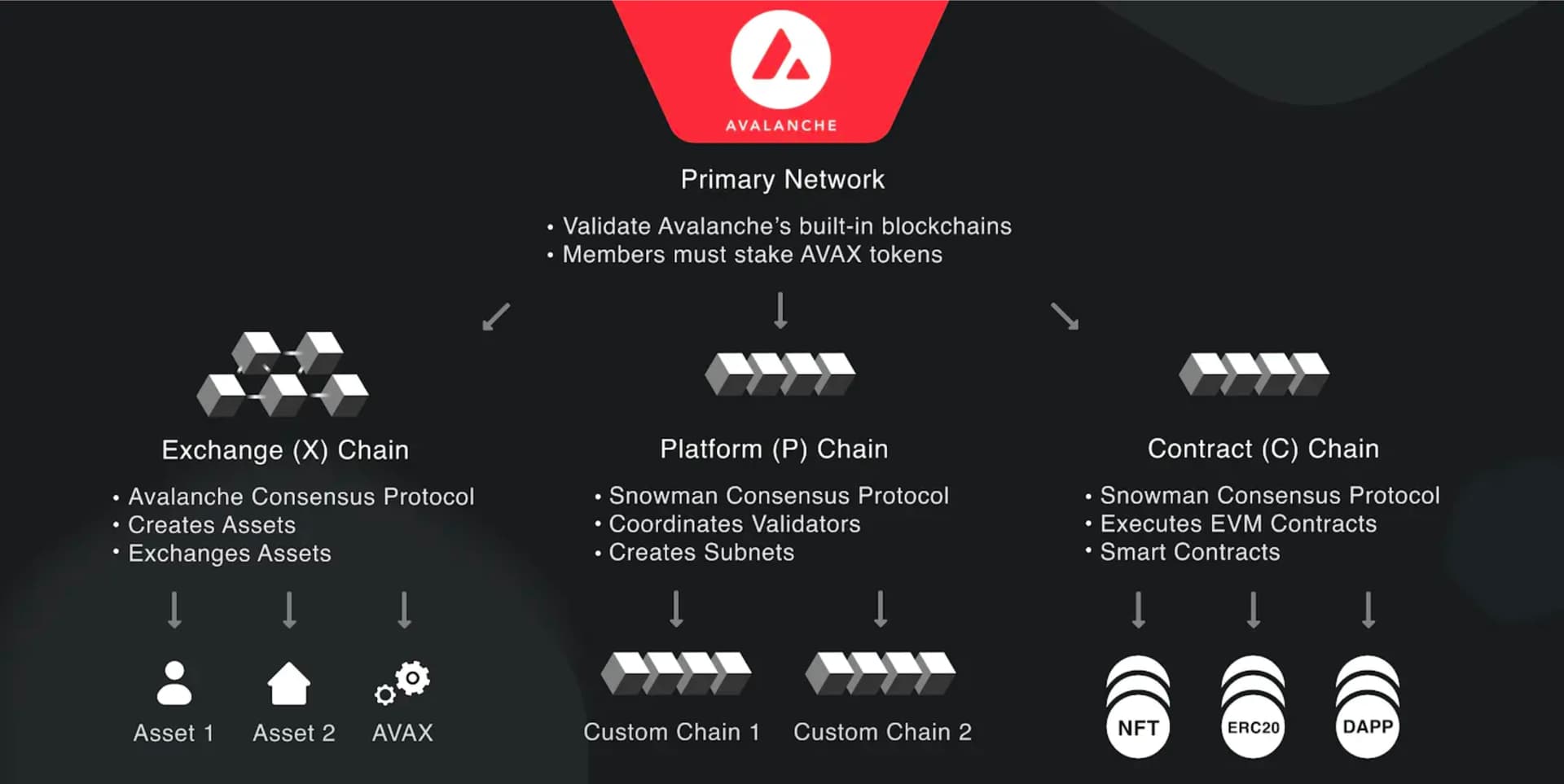
Avalanche operates as a collection of distinct blockchains rather than a single monolithic chain. At its core is the C-Chain (Contract Chain), which handles standard Ethereum Virtual Machine (EVM) smart contracts and serves as the primary interface for most DeFi applications. However, the network’s true flexibility comes from its subnet architecture, which allows developers to launch isolated, custom blockchains that share security with the main Avalanche network.
Think of the C-Chain as a public highway where all traffic follows the same rules and speed limits. Subnets are like private toll roads or specialized rail lines built alongside it. Each subnet can define its own rules regarding transaction fees, validator sets, and gas limits. This means a DeFi cluster focused on high-frequency trading can operate on a subnet optimized for speed, while a privacy-focused financial service can run on a separate subnet with strict access controls, without slowing down or compromising the main network.
These subnets connect to the C-Chain through Avalanche Warp Messaging (AWM), a communication protocol that enables cross-subnet messaging. This allows assets and data to move between specialized environments securely. By decoupling the consensus layer from the execution layer, Avalanche enables "DeFi clusters"—groups of applications that share infrastructure and security but maintain operational independence. This structure is critical for institutional adoption, as it allows financial entities to customize compliance and performance requirements without relying on third-party layer-2 solutions.
This architectural separation ensures that congestion or security issues in one subnet do not impact others. For market participants, this means greater predictability in transaction costs and finality times. As institutional capital seeks infrastructure that can handle specific regulatory and performance needs, the subnet model provides the necessary granularity to support diverse DeFi strategies within a single, secure ecosystem.
Primary DeFi Cluster Types
Avalanche subnets have moved beyond simple infrastructure experiments to form distinct, high-value DeFi clusters. These clusters are not generic layer-2s; they are purpose-built chains designed to solve specific friction points in decentralized finance, from institutional compliance to gaming liquidity.
The current market is defined by three dominant architectures. Each serves a different segment of the DeFi ecosystem, offering specialized consensus mechanisms and tokenomics that generic blockchains cannot match.
Gaming-Finance Hybrids
Gaming subnets prioritize throughput and low latency over the maximal decentralization of the primary network. By isolating game logic and asset ownership, these clusters enable real-time micro-transactions and complex state changes that would congest a standard chain. The synergy between play-to-earn mechanics and DeFi yield farming creates a closed-loop economy where in-game assets function as collateral or liquidity providers.
Institutional Asset Tokenization
For traditional finance (TradFi), privacy and regulatory compliance are non-negotiable. Institutional subnets offer permissioned access controls and tailored governance models, allowing banks and asset managers to tokenize real-world assets (RWAs) like bonds or real estate on-chain. These chains often integrate with existing KYC/AML frameworks, bridging the gap between regulated markets and decentralized liquidity.
Specialized Stablecoin Chains
Stablecoin subnets focus on capital efficiency and predictable transaction costs. By optimizing for high-volume, low-value transfers, these chains provide a dedicated rail for payments and lending protocols. This specialization reduces congestion fees and ensures that stablecoin movements remain fast and cheap, regardless of market volatility on the broader network.
Comparison of Cluster Metrics
The following table highlights the technical distinctions between these primary DeFi clusters, illustrating why subnet specialization drives efficiency.
| Cluster Type | Primary Metric | Consensus Focus |
|---|---|---|
| Gaming | TPS | Finality Speed |
| Institutional | Compliance | Permissioned Access |
| Stablecoin | Fee Stability | Throughput |
Evaluating Subnet Performance and Liquidity
Market researchers evaluating Avalanche subnet-based DeFi clusters must move beyond aggregate network metrics. Subnets operate as distinct economic environments, meaning liquidity depth, transaction costs, and user adoption vary significantly between clusters. Relying on main-chain data obscures the specific health of these isolated environments. Accurate analysis requires drilling down into subnet-specific telemetry to understand where capital is actually flowing.
Liquidity depth is the primary indicator of a subnet’s viability. Researchers should monitor on-chain data to assess the stability of liquidity pools and the volume of stablecoin activity within each cluster. Subnets designed for specific verticals, such as gaming or institutional finance, often exhibit different liquidity profiles than general-purpose DeFi hubs. Tracking these patterns helps identify which clusters are attracting sustained institutional interest versus speculative inflows.
Adoption trends are best measured by active user counts and transaction frequency rather than total value locked (TVL) alone. TVL can be inflated by large, inactive deposits, while active metrics reveal genuine utility. By cross-referencing user engagement with liquidity stability, researchers can distinguish between healthy, growing clusters and those facing liquidity fragmentation.
For broader market context, comparing the native asset’s performance against subnet-specific activity provides a holistic view. The price action of AVAX often reflects overall ecosystem confidence, but subnet-level data reveals where that confidence is being deployed. This dual-layer analysis allows for more precise strategic positioning within the DeFi landscape.
Strategic infrastructure implications
Avalanche’s subnet architecture fundamentally changes the economics of blockchain deployment. Instead of forcing every application to compete for the same block space on a single chain, developers can launch isolated Subnets. This creates dedicated environments that handle specific workloads without clogging the main network. For DeFi clusters, this means predictable transaction costs and consistent finality, which are non-negotiable for high-frequency trading and institutional-grade applications.
The strategic advantage lies in customization. A DeFi protocol focused on high-yield lending can configure its own validator set and economic parameters, optimizing for security over throughput, while a gaming-related cluster prioritizes speed. This modularity allows investors to back projects that align with specific risk profiles rather than betting on a one-size-fits-all solution. It transforms the network from a monolithic chain into a flexible infrastructure layer that adapts to market demands.
Cross-chain interoperability via Avalanche Warp Messaging (AWM) further tightens these clusters. AWM enables Subnets to communicate directly, allowing assets and data to move between isolated environments without relying on slow, bridge-heavy external protocols. This creates a cohesive ecosystem where liquidity can flow freely between specialized DeFi clusters, enhancing capital efficiency while maintaining the security boundaries of each individual Subnet.
Evaluating Subnet Investment Risks
Building a subnet-based DeFi cluster introduces distinct risks that differ from investing in monolithic Layer 1s. The primary concern is liquidity fragmentation. When capital is distributed across multiple specialized subnets, no single chain achieves the deep order books necessary for large-scale trading. This thin liquidity can lead to significant slippage and price impact, making the ecosystem vulnerable to manipulation during periods of volatility. Investors must assess whether the projected user growth on specific subnets, such as gaming or enterprise applications, is sufficient to consolidate liquidity back into the core Avalanche chain.
Regulatory uncertainty adds another layer of complexity. Subnets allow for customizable virtual machines and governance structures, which can sometimes operate outside the strict compliance frameworks of the main Avalanche network. If a subnet is used for activities that attract regulatory scrutiny, it could create reputational or legal spillover effects. While Avalanche positions itself as a high-performance platform for builders, the decentralized nature of subnets means that oversight is not uniform. Investors should carefully review the governance models and compliance features of each subnet they intend to support.
Technical complexity also poses a barrier to entry and adoption. Subnets require validators to run specialized nodes, which increases operational costs and the potential for technical failures. The interoperability between subnets and the main Avalanche chain is still evolving, creating risks related to cross-chain messaging and asset bridging. These technical hurdles can slow down adoption and limit the utility of the DeFi clusters. Understanding these technical nuances is essential for evaluating the long-term viability of subnet-based investments.
-
Assess liquidity depth on target subnets
-
Review governance and compliance frameworks
-
Evaluate technical interoperability risks
No comments yet. Be the first to share your thoughts!